Community › History
The Story of Great Falls
From the Iswa's riverside villages to the roar of hydroelectric turbines— five centuries of history carved along the Catawba River.

The Iswa — People of the River
While the explorer DeSoto passed through the area in 1540, he did not mention any contact with the Catawba Tribe. It was not until 1566 when Juan Pardo came through that the first mention of the Iswa (People of the River) is noted. In an account of the expedition, the town of Issa (Esaw or Iswa) was one among a cluster of villages along a 20-mile stretch of the Catawba River.
“It brought you to the first town of the Catawbas, called Nauvasa—(probably Old Catawba Town) situated on the banks of the Catawba River. Besides this town there were five others belonging to the same Nation laying all on the same stream within a distance of 20 miles.”— William Byrd II, 1732

Revolutionary War
The very first battle in Chester County during the Revolution was fought at Alexander's Old Field in May of 1780, also known as the Battle of Beckhamville. While not a big battle, it marked the beginning of the resistance in the up country.
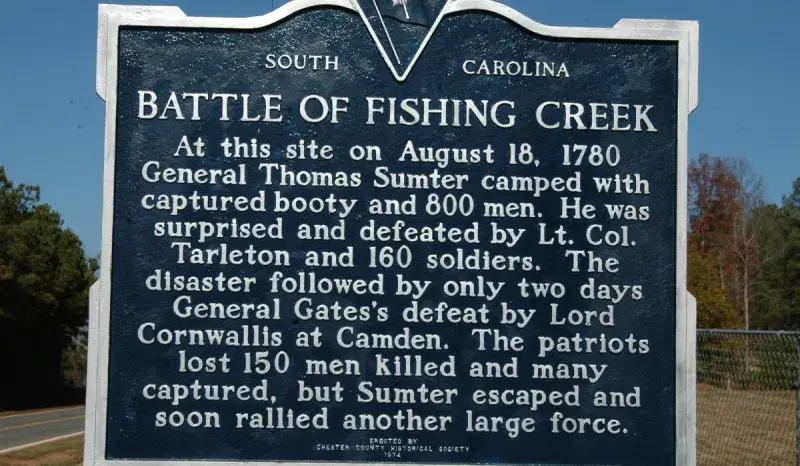
The Battle of Fishing Creek took place August 18, 1780 when Lord Cornwallis (Tarlton) attacked Thomas Sumter. Cornwallis was on Sumter's trail, and as Tarleton crested a hill he could see Sumter and his men below, apparently undisturbed by their sentries' fire. With a shout, Tarleton and his men descended upon them. Sumter tried to rally his troops but in the end made a hasty escape and found safety in Charlotte, NC.

Mount Dearborn
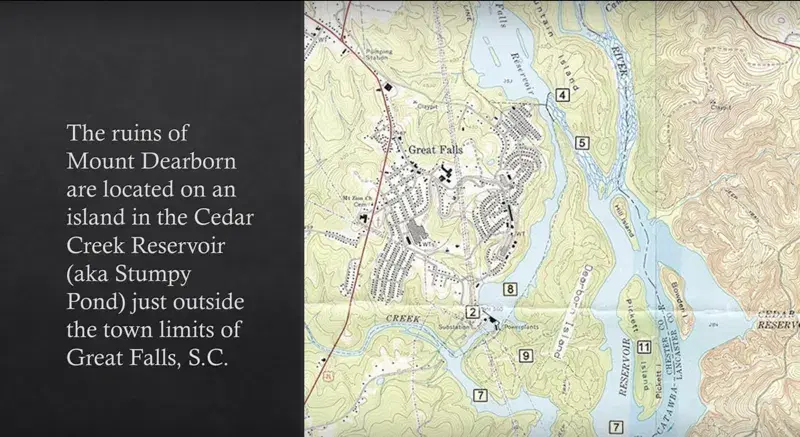
In 1794–95, the federal government set out to build an arsenal/armory on the Potomac and one near the line between the Carolinas. The site near the great falls was selected by Eli Whitney and Major Christian Senf. Thomas Jefferson authorized the purchase of 523 acres from Senator Thomas Sumter. The cornerstone for the arsenal was laid in 1803 by Henry Dearborn, Secretary of War, serving under President Thomas Jefferson. The last soldiers left the arsenal in 1817.

Electricity!
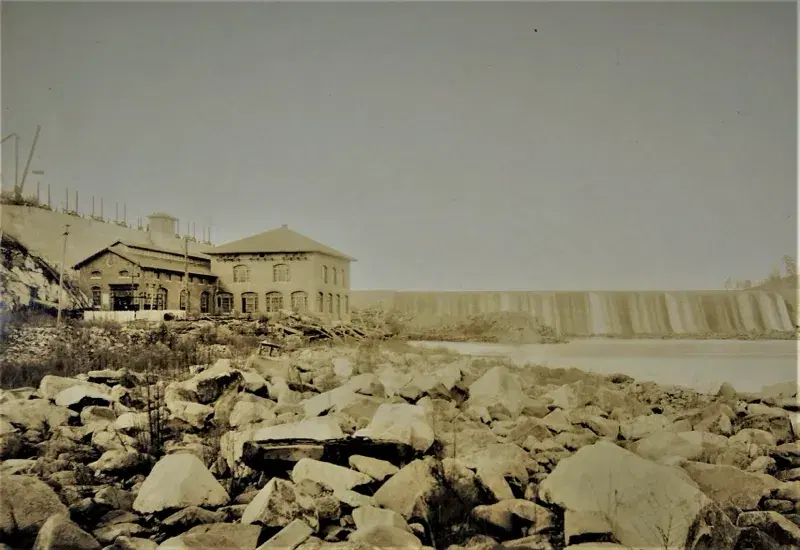
In 1905, the Southern Power Company, a forerunner of Duke Energy, was incorporated. It began with its first hydroelectric plant called the Great Falls Station. Two spillway dams were constructed to feed the turbines, turning the water away from its natural path and leaving tons of rock exposed.
Shortly after the Great Falls Station, the company began construction on the Rocky Creek plant. A third plant, Fishing Creek, was completed in 1916. The Dearborn Plant at the Great Falls site was completed in 1925, with the Cedar Creek Plant at Rocky Creek completed in 1926. The Great Falls Hydro-Electric Power Plant turbines were filled with concrete in 2020.
The Southern Power Company Hotel, razed in the late 1950's, stood on what was known as the Power Hill—later Duke Power Hill. Engineers, doctors, and overseers stayed here where three meals a day were served. J.B. Duke stayed during his weekly visits until the railroad was completed, when he then stayed in his private, richly appointed train coach.

The Town Built by the Republic Cotton Mills
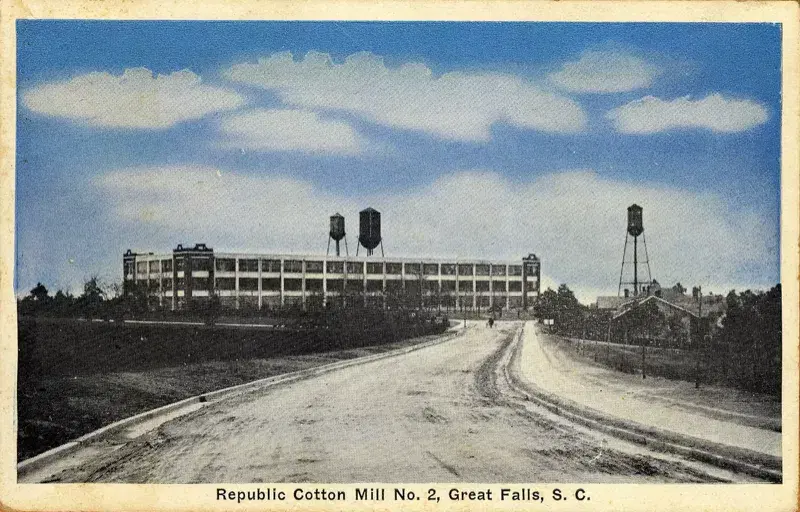
Construction of the Republic Cotton Mill buildings began in 1909 and was in operation by 1911 with 175 hands turning out cotton cloth for prints. It was such a successful enterprise that a second plant was built in 1916. Some 208 acres had been purchased, and soon after the mill buildings began to rise, the town itself began to take shape—streets were laid out and houses were constructed.
The first village for employees had 75 houses ranging from 3 to 6 rooms, equipped with water, sewerage, and electric lights. The company owned a department store with groceries, dry goods, a pharmacy, and millinery goods— they even had a department that handled coffins and caskets.
In 1923, Republic Cotton Mill #3—a silk mill—was built with a unique saw-tooth roof. In 1948, Republic Cotton Mills merged with J.P. Stevens & Company, Inc., which remained the major employer for most of the 20th century. All three mills closed in the early 1980's, with Mill #2 the only one still standing.
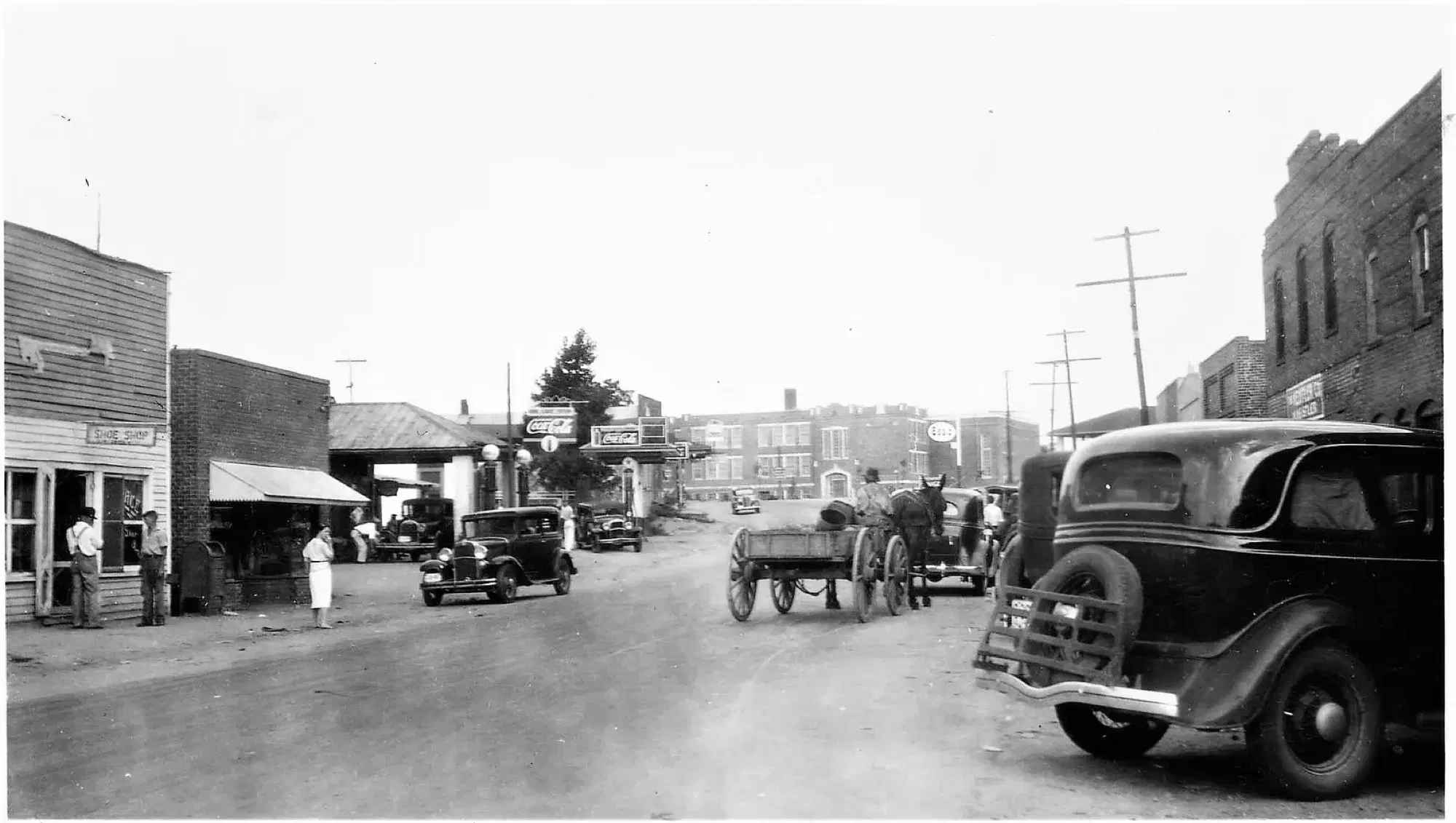
Flopeye
There is a section of the Great Falls business district that goes by this unusual name. Originally and officially this section is Elizabeth Heights. The name “Flopeye” has been around since at least 1915.
How the name came about is the subject of much discussion. However, according to local historians, the original Flopeye was a man with a bad eye. This man would go to sleep in a chair in front of his store just about every day. A girl was walking by one day while the man was asleep and declared, “It's Flop Eye.”
The history above is from: Great Falls, South Carolina, compiled by Millard C. Smith & Jean S. Camp. A publication of the Chester County Historical Society. Copies of the publication are available at Town Hall.